


.svg)
Venture Medical and Plasmacure Explore the Future of Cold Plasma at IPAWS



Venture Medical and Plasmacure recently came together at IPAWS in New Orleans to introduce wound care professionals to PLASOMA® and explore the potential role of cold atmospheric plasma in the future of advanced wound care in the United States.
During the event, Bjorn Sprengers, CEO of Plasmacure, presented “Introduction to Cold Plasma and Its Potential for Wound Care in the U.S.” His talk provided an overview of cold plasma science, PLASOMA’s technology, European clinical findings, and the pathway toward introducing this emerging technology to the U.S. market.
A Partnership Focused on What Is Next
Venture Medical and Plasmacure announced their strategic development and distribution agreement in May 2025. Through the partnership, Venture Medical is supporting the U.S. regulatory and commercialization strategy for PLASOMA.
Following the necessary regulatory authorization, Venture Medical will serve as Plasmacure’s exclusive commercialization partner in the United States, supporting market entry, clinical education, and nationwide distribution.
This collaboration reflects Venture Medical’s continued commitment to identifying and supporting meaningful advancements that have the potential to improve wound care delivery, clinical outcomes, and the overall patient experience.
What Is Cold Atmospheric Plasma?
Despite its name, cold plasma is not related to blood plasma. Plasma is commonly described as the fourth state of matter and is created when energy is applied to a gas, producing charged particles and reactive species.
When plasma is generated near room temperature and under atmospheric pressure, it is known as cold atmospheric plasma, or CAP.
A growing body of scientific literature has examined CAP’s potential antimicrobial and biological effects, including its interactions with bacteria and biofilm, reactive oxygen and nitrogen species, microcirculation, and cellular processes involved in tissue repair.
During his presentation, Sprengers explained that these multiple mechanisms could make cold plasma a versatile technology for addressing some of the barriers associated with complex wound healing.
How PLASOMA Works
PLASOMA is Plasmacure’s cold plasma system for complex wound care. The system uses volume-based dielectric barrier discharge technology to generate plasma directly within the wound area.
It consists of an electronic pulser and a flexible plasma pad placed over the wound. The technology combines cold atmospheric plasma with mild electrical stimulation, an approach Plasmacure refers to as DUAL Plasma.
The closed system is designed to deliver plasma directly to the wound while minimizing external ozone emissions. Treatments used in European care settings take approximately two minutes and can be incorporated into existing wound care routines.
Examining the Clinical Evidence
Sprengers highlighted findings from a randomized controlled trial evaluating PLASOMA in patients with chronic venous leg ulcers.
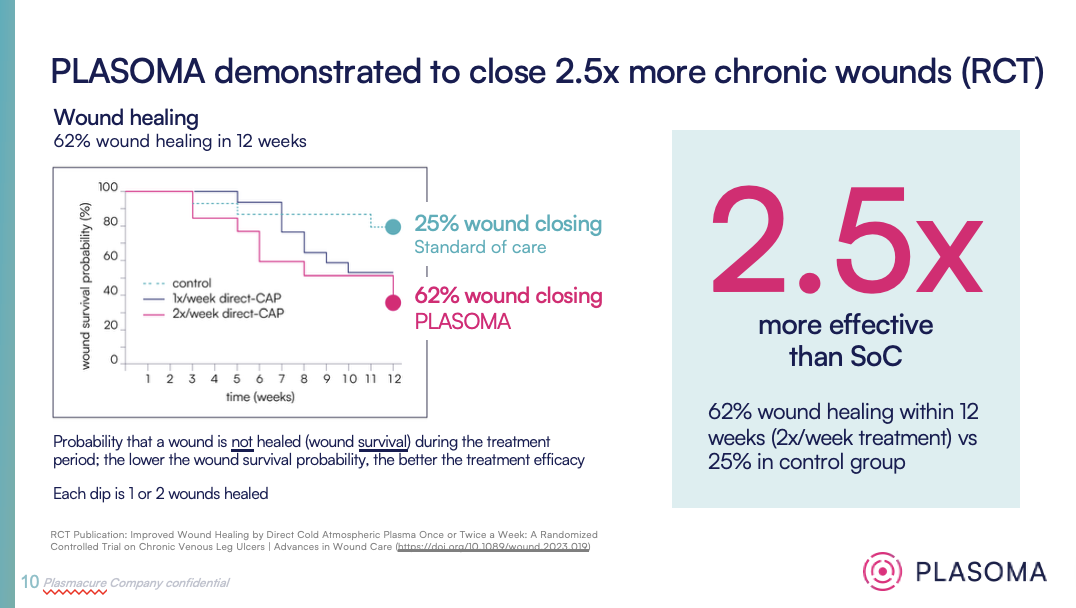
The study included 46 patients divided among three treatment groups. One group received standard wound care alone, while the other groups received standard wound care with PLASOMA treatment either once or twice per week.
Within 12 weeks:
- 62% of wounds in the twice-weekly PLASOMA group achieved closure
- 53% of wounds in the once-weekly PLASOMA group achieved closure
- 25% of wounds in the standard-care group achieved closure
The study also reported greater wound-area reduction in the groups treated with PLASOMA. These findings are specific to chronic venous leg ulcers and the population evaluated in this study. Results should not be generalized to every wound type or patient.



Categories


Navigating WISeR: What Wound Care Providers Need to Know and How Venture Medical Can Help
The WISeR Model is here, and it's changing the way wound care providers submit and manage their Medicare claims. Learn what WISeR means for your practice, why accurate documentation is more critical than ever, and how Venture Medical is working hand-in-hand with providers to navigate the process with confidence.

How Venture Medical Is Helping Providers Build Practices That Last
Venture Medical remains committed to being a long-term partner to providers by giving them the strategies and tools they need to build sustainable, resilient practices for the long haul.Venture Medical's ongoing 2026 webinar series is focused on helping wound care providers build practices that can absorb disruption rather than react to it. Learn more about this webinar series and watch the recaps of the sessions you might have missed.

Why Defensible Documentation Is the Most Important Business Decision You Will Make in 2026
In an era of tightening payer scrutiny and rising audit activity, the practices that thrive will be the ones that treat documentation as a clinical and operational standard, not an afterthought. This blog breaks down what medical necessity really means, what "defensible" documentation looks like, and how the right workflows and technology can make excellence achievable every single day.




Missoula, Montana